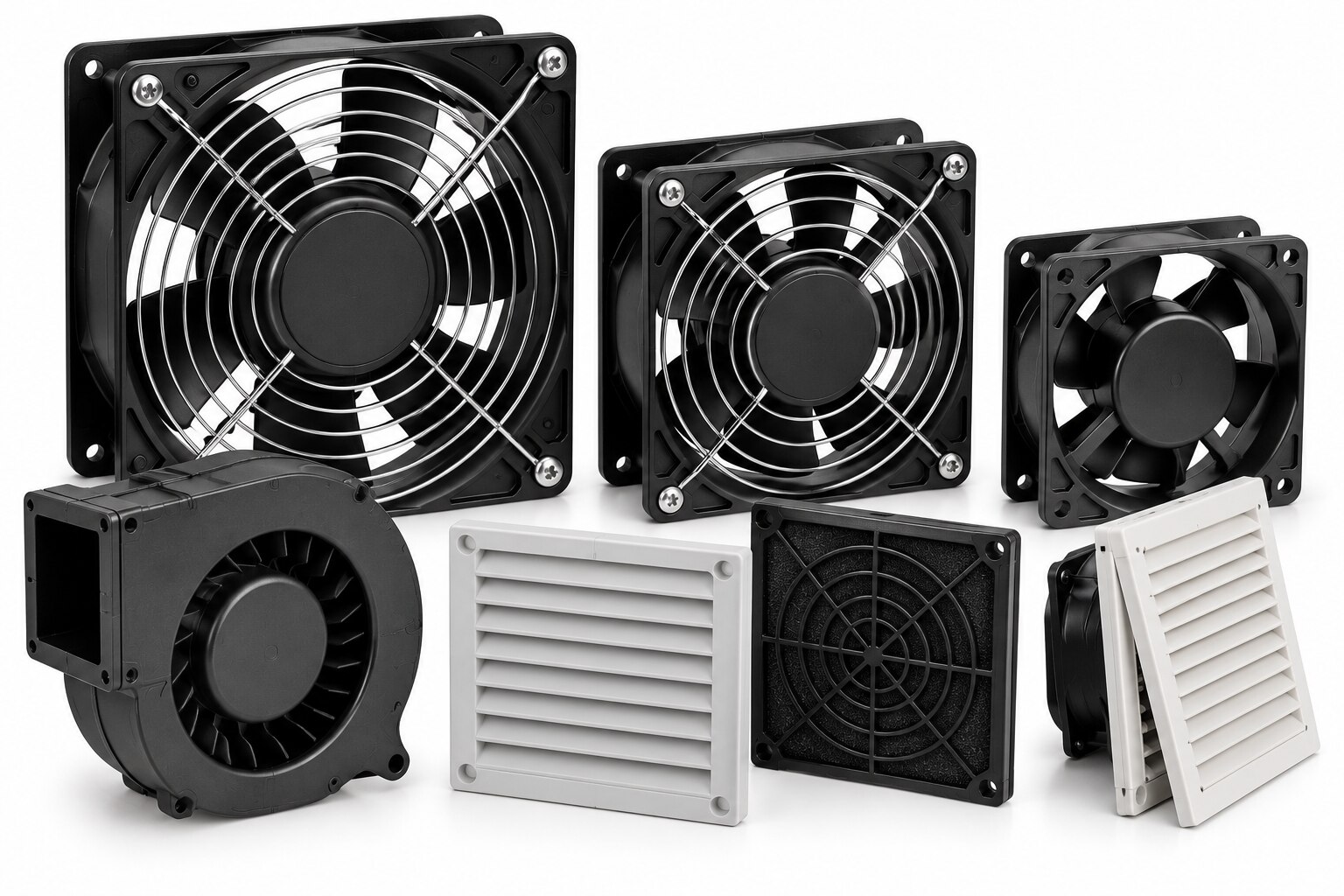
Heat inside an electrical enclosure comes from every device that dissipates power, not only from the largest drive or breaker. By the end, you will be able to trace those heat sources, estimate the airflow required, plan a real intake-to-exhaust path, and check whether a fan is suitable for the enclosure’s environment and protection rating.
Key takeaways
- Calculate airflow from total heat loss and the allowable temperature rise.
- Place filtered intake low and exhaust high to move air across hot components.
- Check filter loading, ingress protection, voltage, noise, and fan control before installation.
- Choose a heat exchanger or air conditioner when ambient air is too hot or contaminated.
How heat builds up and damages enclosure components
Electrical enclosure heat begins with electrical losses. Contactors, motor-protection circuit breakers, power supplies, variable-frequency drives, transformers, busbars, terminals and conductors all convert part of their electrical energy into heat. Nameplate current is not a heat-loss value; resistance, switching losses and conversion efficiency determine the watts released inside the cabinet.
Warm air rises and collects at the top, while dense wiring and high-loss devices restrict circulation. That stratification creates local hot spots even when the average air temperature looks acceptable. Excessive temperature causes nuisance trips, insulation deterioration, terminal loosening, semiconductor stress and shortened service life.
Check the thermal risk at these points:
- Measure or calculate the temperature at the hottest drive, power supply, bus connection, terminal and densely wired section.
- Treat the maximum permitted temperature of the most sensitive component or terminal as the limit, not the enclosure’s average air temperature.
- Use an internal circulation fan to reduce stratification and spread heat; it cannot remove heat from a sealed enclosure.
- Provide a heat path through the walls, ventilation openings, a heat exchanger or an air-conditioning system.
IEC/TR 60890 provides a thermal-verification calculation method for low-voltage switchgear and controlgear assemblies. Select control-panel cooling against the assembly manufacturer’s temperature-rise documentation, because a fan that improves airflow alone does not prove compliance or eliminate thermal stress.
How to estimate the airflow a panel fan must deliver
Use the total heat loss in watts and the temperature rise you can permit. The preliminary heat-balance formula is Q ≈ 0.34 × airflow in m³/h × allowable temperature rise in K, where Q is enclosure heat loss.
1. Inventory losses from drives, power supplies, transformers, contactors, terminals and conductors. Do not substitute nameplate current: current identifies loading, not the watts converted into heat. Use manufacturer loss data or calculate each device’s electrical loss.
2. Set the allowable temperature rise as the permitted internal air temperature above the actual ambient temperature. Base it on the most temperature-sensitive component or terminal, not the enclosure’s average air temperature.
3. Rearrange the formula for panel fan sizing: airflow in m³/h = Q ÷ (0.34 × allowable temperature rise in K). For example, 340 W with a 10 K rise requires about 100 m³/h before system losses.
4. Convert the result when comparing catalogues: CFM airflow = m³/h × 0.589. Thus, 100 m³/h is approximately 59 CFM airflow.
5. Correct the airflow calculation for the actual ambient temperature and altitude. Lower air density at altitude reduces heat carried by a given volume of air, so confirm the manufacturer’s correction data.
6. Select against the fan curve or pressure-drop data. A catalogue’s nominal airflow usually means free-air, or zero static pressure; filters, louvers, guards, grilles, heat exchangers and restricted openings reduce delivered flow.
Treat this as an estimate, not assembly verification. Check it against IEC/TR 60890 and the assembly manufacturer’s temperature-rise documentation.
How to create an airflow path without sacrificing protection
Put the intake low and the exhaust high, with openings on separated faces when the enclosure and environment permit it. This arrangement lets forced airflow follow natural buoyancy and reduces the chance that discharged hot air returns directly to the intake.
1. Use an intake fan to push outside air into the enclosure. Use an exhaust fan to pull heated air out. A filtered fan combines a fan with a replaceable filter, while a filter grille is a passive, filtered opening with no motor.
A common arrangement uses a filtered fan at the bottom and an exhaust fan or filter grille at the top.
2. Keep the intake and exhaust apart, preferably on opposite or adjacent faces. Placing both openings on one side can short-circuit the path, sending fresh air straight to the outlet while hot air remains around drives, power supplies and terminals. An internal circulation fan alone only redistributes heat inside a sealed enclosure.
3. Treat every opening as a protection compromise. Dust, water, oil mist and corrosive contaminants become easier to admit as ventilation increases. An IP54 or IP55 enclosure needs a complete, suitable fan-filter-louver assembly; an arbitrary cutout does not preserve its original rating.
IP65 is a warning: open ventilation is usually unsuitable unless the complete solution is specifically rated and tested.
4. Provide access to inspect and replace the filter without disturbing live wiring. Inspect it monthly at first and set the replacement interval from measured loading and site conditions. A clean filter can deliver design airflow; a clogged filter creates pressure drop and overheating, so use a dirty-filter alarm where continued operation matters.
What to check before installing and controlling a panel fan
A reliable panel fan installation starts with a physical fit check, not the airflow rating alone. Confirm these details against the enclosure drawing and the fan manufacturer’s catalogue drawing:
- Cut-out dimensions and mounting-hole pattern
- Enclosure wall thickness and fan depth behind the mounting surface
- Terminal access for wiring and future testing
- Clearance from live parts, ducts and heat-producing components
- Cable routing that avoids sharp edges, moving parts and blocked airflow
- Door-swing clearance, including the filter frame and replacement space
Use thermostat control or an electronic temperature controller to reduce energy use and fan wear. Position its sensor in the critical thermal zone, such as beside a drive, power supply or dense terminal group—not in the discharge stream, where falsely cool air can delay operation.
A thermostat does not prove that the motor is running. For a critical panel, specify fan-failure contacts, tachometer monitoring, a high-temperature alarm or controlled shutdown; larger systems may need redundant fans.
Fan choice also involves noise and filter loading:
| Option | Advantage | Main drawback |
|---|---|---|
| Larger, slower fan | Lower noise and better pressure margin | Requires more mounting space |
| Smaller, faster fan | Compact and easy to fit | Noisier and more sensitive to clogged filters |
Compare fan curves, terminal arrangements and replacement-filter availability before ordering. Dollex Control Panel Accessories can be considered alongside other industrial suppliers when matching the fan, filter assembly, thermostat, alarm contact and enclosure hardware as one installation.
Related product
 | Fans Panel fans are efficient cooling devices that use a flat, compact design to circulate air in tight spaces. View product → |
When a fan is the wrong cooling method
Stop increasing airflow when outside air is hotter than the permitted internal temperature or carries conductive dust, corrosive vapour, moisture or an explosive atmosphere. Ventilation then imports the problem instead of removing heat.
| Option | What it does | When it applies |
|---|---|---|
| Closed-loop enclosure air conditioner | Recirculates sealed internal air across a cooling circuit | Outside air is too hot or contaminated |
| Air-to-air heat exchanger | Transfers heat through separating surfaces without mixing air streams | You need cooling without outside-air contamination |
| Purged system | Maintains protective positive pressure with a controlled purge gas | The enclosure faces an explosive atmosphere |
Fans do not dehumidify. Large day/night temperature swings can create condensation, so condensation control may require a hygrostat, anti-condensation heater and drainage provision suited to the enclosure arrangement.
A panel fan matters only when the enclosure, environment and protection requirements support ventilation. It provides a controlled heat-removal path; internal circulation alone merely redistributes heat.
Commission the installation in this order:
- Verify the actual heat-load estimate and complete thermal verification.
- Inspect intake and exhaust separation for recirculation.
- Measure temperature at the hottest component and terminal.
- Confirm airflow after the filter is installed.
- Test the fan-failure alarm.
- Recheck performance through a dirty-filter maintenance plan.
Frequently asked questions
How does heat build up inside an electrical enclosure?
Electrical losses from drives, power supplies, contactors, transformers, conductors, and other components become heat. Enclosed air cannot reject that heat fast enough, so internal temperature rises.
How do you estimate the airflow a panel fan must deliver?
Add the heat loss in watts, set the maximum permissible internal temperature rise, and use the required airflow relationship. Select a fan for the calculated duty after allowing for filter and grille pressure losses.
How do you create an airflow path without sacrificing enclosure protection?
Use a filtered intake low on one side and a filtered exhaust high on the opposite side. Match the fan, filter, grille, and enclosure cut-outs to the required ingress-protection rating.
What should you check before installing and controlling a panel fan?
Verify supply voltage, rated airflow, operating temperature, noise, filter access, cut-out dimensions, IP rating, and control compatibility. Use a thermostat or enclosure temperature controller when automatic operation is required.
When is a panel fan the wrong cooling method?
Do not use an air-exchange fan when ambient air is hotter than the permitted enclosure temperature or contains dust, moisture, oil vapour, or corrosive contaminants. Use a heat exchanger or enclosure air conditioner instead.