A cable tie that looks suitable in a catalogue can fail because its length, material, temperature rating, mounting method or installation tension does not match the wiring environment. By the end, you will be able to define the bundle size, select the right tie material, check the evidence behind performance claims and specify a support system that will remain safe in service.
Key takeaways
- Use nylon 6/6 only in dry, moderate-temperature indoor panels.
- Measure bundle diameter before selecting tie length and tensile strength.
- Specify resistance to heat, chemicals, UV exposure and flame where required.
- Match the tie, mounting base and installation tool to the support system.
Match the tie material to the panel or installation environment
Choose standard nylon 6/6 for a dry, indoor control panel with moderate temperature and no aggressive chemicals. It is the wrong choice outdoors, beside heat sources, or where oil, solvents, acids or cleaning agents attack nylon.
| Option | Suitable location | Wrong choice when |
|---|---|---|
| standard nylon 6/6 | Dry indoor panels and protected machine wiring | The installation faces sunlight, sustained heat, moisture or chemical exposure |
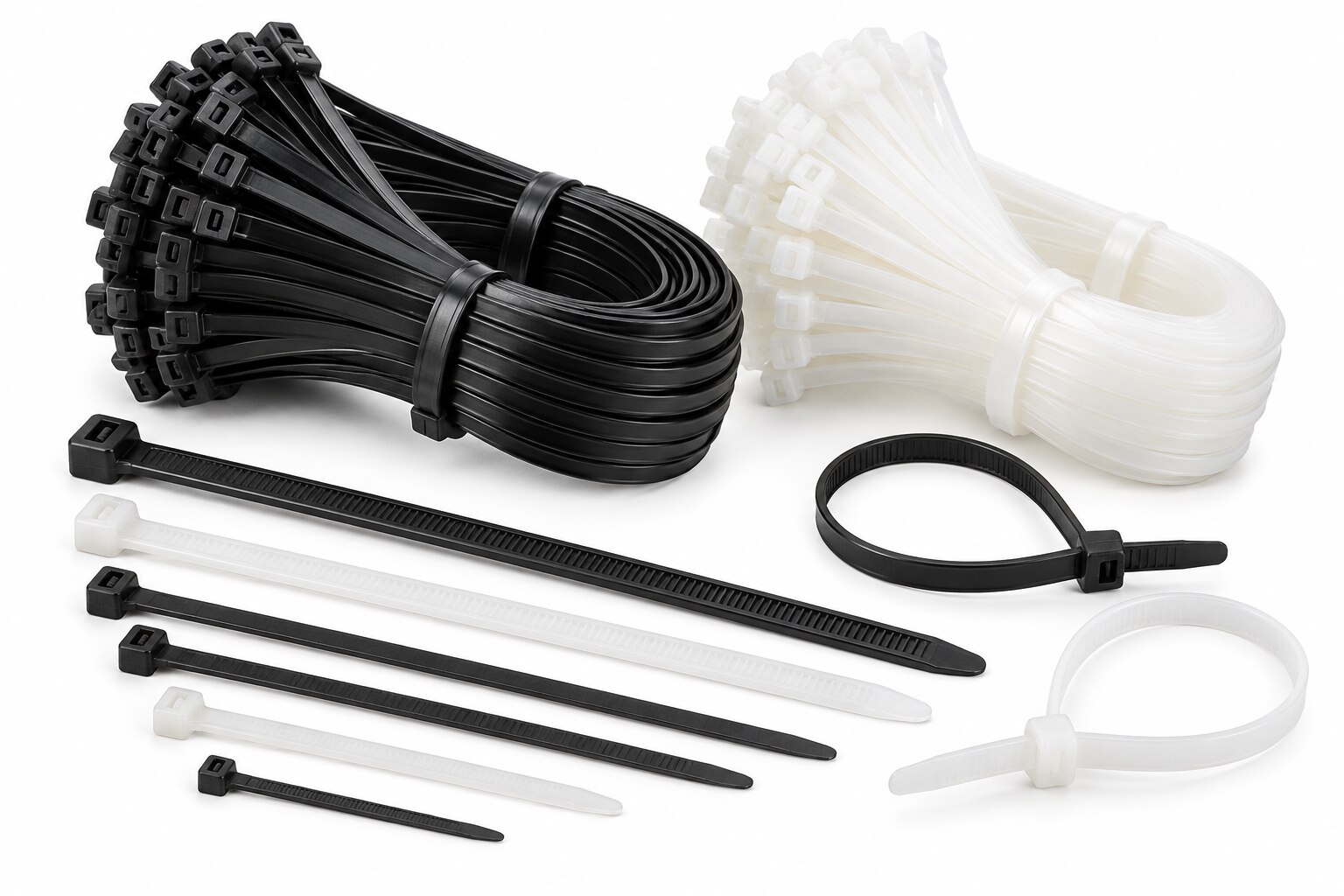
| White nylon cable ties | Indoor wiring where inspection, colour identification and clean appearance matter | The tie is exposed to ultraviolet light; natural nylon can become brittle and lose strength |
| UV-stabilised black nylon | Outdoor runs, rooftop equipment and panels exposed to sunlight | The datasheet does not state UV resistance or outdoor use; black colour alone proves nothing |
| Heat-stabilised nylon ties | Warm panels and wiring near equipment that exceeds ordinary nylon’s temperature range | The environment contains solvents, concentrated chemicals or temperatures beyond the stated rating |
| Stainless-steel ties | High heat, severe vibration, outdoor exposure or chemical service where polymer ties fail | Metal could abrade insulation, contact live parts, or conflict with the enclosure’s corrosion-control requirements |
Match the material to the exposure, not the label “industrial grade.” Ask for the operating-temperature range, chemical compatibility, UV rating and flammability claim; halogen-free does not mean low-smoke, flame-retardant or plenum-rated.
For a certified panel or machine, verify the tie, mounting base and intended combination against the certification file and IEC 62275 or UL 62275 listing. Releasable ties suit commissioning, but their release mechanism is a poor choice for inaccessible, high-vibration permanent wiring.
Calculate tie length, bundle diameter and usable strength
Measure the bundle around its outside, then perform the cable-tie length calculation: required length equals bundle circumference plus the tie head and locking-mechanism allowance, with enough tail left for reliable engagement. For a round bundle, circumference is approximately 3.14 × diameter; for an irregular bundle, measure the actual path with a tape.
Do not choose by nominal length alone. Check these catalogue values together:
| Specification | What to check | Why it matters |
|---|---|---|
| Nominal length | Usable length after the head allowance | A long-looking tie can still leave too little tail for locking |
| Maximum bundle diameter | The manufacturer’s stated upper limit | It reflects the tie’s intended overlap and locking position |
| Minimum loop diameter | The manufacturer’s stated lower limit | An oversized tie may not grip a small bundle securely |
| Width and tensile strength | The specified grade and loop-test value | Width affects handling; tensile strength identifies breaking performance, not a working load |
Select a tie whose stated diameter range contains your actual bundle size. A bundle near the maximum bundle diameter leaves little allowance for added conductors, labels or rework.
Treat tensile strength as a minimum breaking result, not a permitted working load. Do not convert it directly into a supported weight. Vibration, temperature, chemicals, support spacing and tightening damage change the usable capacity.
The tie, base, fastener and panel form one support system. The weakest part controls it, so a strong tie attached to a weak adhesive mount or thin screw is not a strong assembly. For load-bearing runs, use the manufacturer’s assembly rating or engineering approval rather than guessing a safety factor from the tie’s tensile figure.
Check temperature, chemicals, fire performance and product standards
Verify the tie’s operating temperature, chemical resistance, fire performance and certification before approving it. Separate the short-term installation limit from the continuous-use limit, then check tensile retention at the panel’s actual temperature. Heat can accelerate nylon creep, allowing a bundle to sag even when the original tensile rating looks adequate.
| Installation | Specifications to verify | Consequence of a mismatch |
|---|---|---|
| Hot panel | Continuous-use temperature, installation-temperature limit, tensile retention, material grade and flammability rating | Heat can soften the tie, increase nylon creep or reduce holding force |
| Outdoor run | UV exposure rating, moisture conditioning, operating temperature and the chemical compatibility chart | Sunlight, water and contamination can embrittle the tie or reduce its strength |
| Certified machine | IEC 62275 compliance, UL 62275 status where required, marking, flammability rating, and approval of the tie, mounting base and intended combination | An approved polymer tie alone may not satisfy the machine’s certification file |
Do not treat “industrial grade” as a standard. IEC 62275 addresses mechanical performance, environmental conditioning, marking and installation-related characteristics for metallic and non-metallic ties. For a UL-certified panel or machine, match the exact tie and base combination to the certification documentation.
Read the moisture conditioning behind every nylon 6/6 strength figure: dry material is not representative after absorbing atmospheric moisture. Use the chemical compatibility chart at the actual concentration and temperature; polypropylene, fluoropolymer and stainless steel each solve different exposure problems.
Specify UV resistance and a flame rating such as UL 94 V-2 or V-0 only when the equipment standard accepts it.
Design the tie, mount and installation method as one support system
Treat the tie and its mounting point as one support assembly: vibration will expose the weakest element, not the tie’s catalogue tensile rating. Select the cable-tie mounting base for the panel thickness, fastener size and expected load; a thin sheet or loose rivet can fail while the tie remains intact.
Choose the mounting method by installation demand:
- Use screw-, rivet- or weld-mounted bases for permanent, high-vibration or load-bearing wiring.
- Use adhesive-backed mounts only on a clean, dry, compatible surface with the manufacturer’s specified application temperature and dwell time.
- Use a positive-locking, non-releasable tie for inaccessible permanent wiring; reserve reusable ties for commissioning and service access.
Install the tie with controlled tension. It should restrain bundle movement without flattening insulation, reducing conductor clearance or deforming shielded and coaxial cable. Excess tension also concentrates force at the tie head, where vibration can initiate jacket damage. Set the tool consistently across production work rather than relying on hand-tightening.
Cut the tail with a flush-cutting tool designed for cable ties. A side cutter can leave a sharp tab that injures hands or abrades adjacent insulation; forcing the cutter against the head can also crush the lock. Keep the cut square and flush, then check that no edge contacts a cable.
For certified panels or machines, verify the tie, mounting base and intended combination against the certification file and UL 62275 requirements. A recognised polymer tie alone does not prove that the complete support system is acceptable.
Turn the comparison into a purchase specification
Your purchase specification should identify the complete cable-tie system, not just “black nylon ties.” Require the supplier to quote the exact part number and provide a current datasheet, marking details and conformity evidence for the specified application.
- Material grade, colour, construction and whether the tie is reusable or non-releasable.
- Overall length, width, minimum loop diameter, manufacturer’s usable bundle-diameter range and tail allowance after locking.
- Minimum tensile strength, with the installation’s permitted working load stated separately; do not treat tensile strength as a tightening target.
- Continuous and intermittent operating-temperature limits, chemical-resistance limitations, UV-resistance or outdoor-use rating, and the cable insulation materials tested for compatibility.
- The flammability rating and test method, plus separate statements for halogen-free and low-smoke claims. Do not accept “halogen-free” as proof of low smoke, flame retardance or plenum suitability.
- Compliance to IEC 62275, including the applicable product marking and environmental-conditioning information.
- Compliance or recognition under UL 62275 when the panel or machine certification requires it, covering the tie, mounting base and specified combination rather than the polymer tie alone.
- Approved mounting-base part number, installation tool, tension setting and cut-off method.
Give the same specification to every bidder, including Dollex Control Panel Accessories, so a lower price cannot conceal a shorter usable length, weaker environmental evidence or an unapproved tie-and-base combination. Reject substitutions unless the supplier resubmits these fields for approval.
Related products
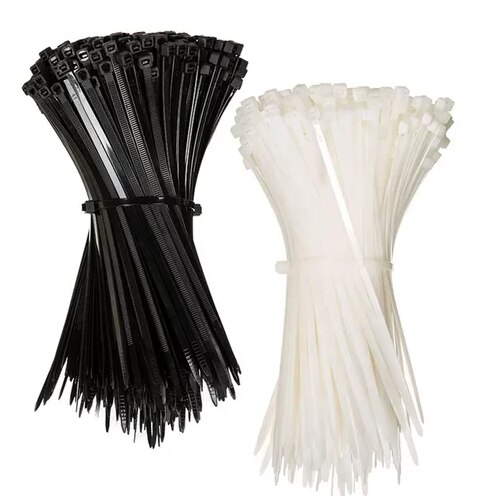 | Dollex White and Black Cable Ties are durable and versatile fastening solutions for bundling wires, cables, and hoses. View product → |
 | Dollex Steel Cable Ties offer superior strength and durability for heavy-duty bundling and securing applications. View product → |
Frequently asked questions
Which cable-tie material suits an electrical panel environment?
Use standard nylon 6/6 for dry indoor panels with moderate temperatures and no aggressive chemicals. Choose a different material for outdoor exposure, heat, oil, solvents, acids or cleaning agents.
How do you calculate cable-tie length and usable strength?
Measure the bundle’s maximum diameter, add enough length for the locking head and tail, then compare the required load with the tie’s rated tensile strength and safety margin.
What cable-tie specifications matter besides size?
Check the operating temperature range, chemical compatibility, UV resistance, flame performance and the product standard or certification required for the installation.
Why should the cable tie, mounting base and installation method be selected together?
The tie must fit the mounting base, support surface and bundle route. Set the installation tool’s tension correctly to avoid crushing insulation or leaving loose wiring.
Related product
 | The Dollex Cable Tie Gun is a professional tool designed for precise tensioning and cutting of cable ties. View product → |