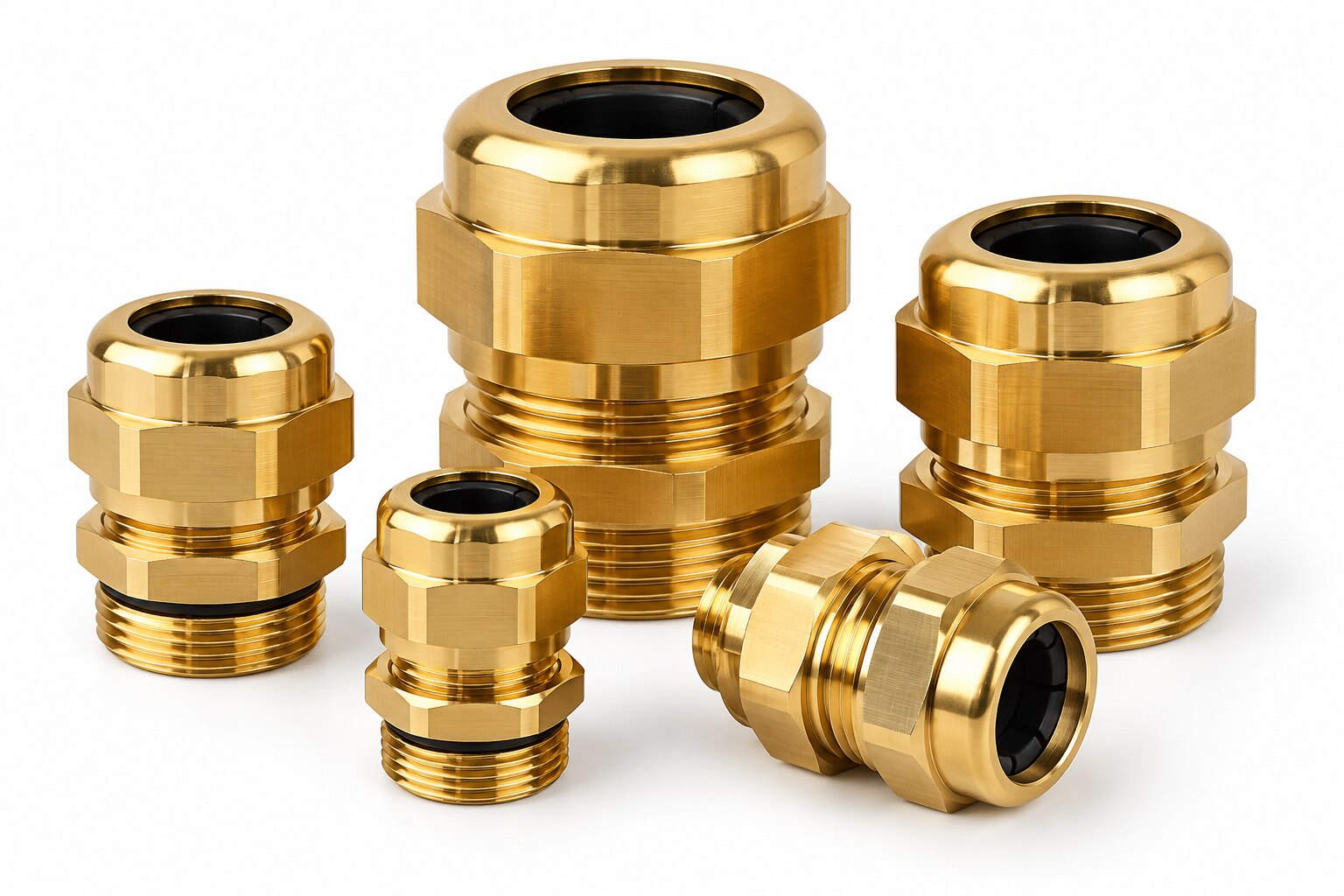
A brass cable gland does not secure a cable simply because the body is metal. You need the correct gland construction, cable diameter range, enclosure thread, sealing parts, and tightening method to achieve both mechanical retention and controlled protection against ingress. By the end, you will know how to specify, install, and verify a brass gland without confusing a threaded entry with a tested cable-entry assembly.
Key takeaways
- Match the gland to the cable’s outer sheath diameter, not conductor cross-section.
- Confirm the enclosure thread, gland thread, locknut, seal, and cable range before buying.
- Tighten the body and cap evenly without cutting, crushing, or twisting the cable sheath.
- Treat the IP rating as an assembly result requiring correct installation and compatible parts.
How the gland holds a cable and closes the entry
A brass cable gland holds a cable securely through several parts working together, not through the metal alone. The gland body supports the entry, while the entry thread and locknut clamp the gland to the enclosure wall. The cable-diameter range must match the cable’s outer sheath; conductor cross-section does not determine the gland size.
- The entry thread provides the fixed mechanical connection to the enclosure. Match its form, such as metric, PG, or NPT, and provide the specified thread engagement.
- The locknut secures the gland body against the panel. Add the specified sealing washer when the enclosure interface requires one.
- The compression nut drives the sealing ring or elastomer inward around the sheath. This creates radial pressure that limits cable movement and forms the seal.
- The gland body and compression assembly transfer pulling and bending forces into the enclosure rather than leaving the cable termination to carry them.
Mechanical security and sealing are different functions. Clamping the sheath resists pull-out and movement; elastomer compression closes the path for dust and water. A tight entry thread cannot compensate for an oversized cable, and a good seal does not prove adequate pull-out or bending resistance.
The installed IP result depends on the cable, hole, washer, locknut, sealing element, and tightening torque together. An IP68 marking on the gland alone does not make an incorrectly sized or loosely fitted entry IP68.
Choose the gland from the cable diameter and enclosure thread
Measure the finished cable outer diameter, then choose a gland whose cable diameter range contains that measurement with room for normal sheath tolerance. Do not size it from conductor cross-section or nominal cable designation. A cable below the minimum may not seal; one above the maximum can crush the sheath or prevent full compression.
Match the gland’s entry thread to the enclosure hole, including nominal diameter, pitch, thread form, and available engagement. M20 × 1.5 accepts a metric cable gland; it is not interchangeable with PG16, even when the visible diameters appear close.
| System | How to identify it | Selection check |
|---|---|---|
| Metric | Marked M16, M20, M25 and a pitch such as 1.5 mm | Match both nominal diameter and pitch to the tapped hole |
| PG | Marked PG7, PG13.5 or PG16; the number belongs to the German Panzergewinde system | Use a PG gland only with a matching PG thread or correctly specified conversion plate |
| NPT | Marked 1/2-14 NPT or 3/4-14 NPT; the thread is tapered and uses threads per inch | Match the NPT size and pitch; do not force it into a metric or parallel hole |
| Other systems | BSP, including G or R designations, uses its own diameter, pitch and thread form | Confirm the enclosure drawing and required thread engagement before ordering |
Check whether the entry is threaded, clearance-drilled, or mounted through a knockout. A locknut, sealing washer, or adapter may be required for a clearance hole. Select an armoured-cable gland when armour must be clamped and bonded; an unarmoured type cannot secure armour by cable diameter alone.
Do not infer tightening torque from thread size—use the gland maker’s value for that cable and seal.
Install and tighten the gland without damaging the cable
A reliable cable gland installation starts with the finished cable diameter, not the conductor size. Check that measurement against the gland’s stated range; an undersized cable leaves the sealing ring loose, while an oversized cable can be crushed before the seal closes.
1. Deburr and clean the enclosure hole, then confirm the thread form and engagement. Fit the gland body from the correct side, adding the specified sealing washer or O-ring, and tighten the locknut by hand.
2. Feed the cable straight through the gland without twisting it. Leave enough slack inside the enclosure to prevent the cable pulling sideways on the entry, and keep the outer sheath intact where the sealing ring will grip.
3. Hold the gland body so it cannot turn, then tighten the locknut to the manufacturer’s torque. On a thin enclosure wall, use the specified washer or support arrangement; a spinning body can scrape the hole and loosen the entry.
4. Tighten the compression nut only after the cable is positioned. Use the published torque for that exact gland, seal material, and cable diameter. Thread size alone cannot provide a safe torque value.
5. Check the completed strain relief by applying a firm hand pull to the cable. It must not slide, rotate, or transfer force to the terminals; the seal must grip without cuts, bulges, or a flattened sheath.
Do not substitute a generic torque for an armoured, screened, or hazardous-area gland. Follow its installation drawing and certification, because the tightening sequence can differ.
Read IP ratings as assembly results, not promises from the metal
IP54 means the completed cable entry limits dust ingress and resists water splashed from any direction. The code belongs to the installed assembly, not to the brass body alone.
| Rating | Solid-particle protection | Water protection |
|---|---|---|
| IP54 | Dust ingress is limited; no harmful deposit | Splashes from all directions |
| IP65 | Dust-tight | Water jets from any direction |
| IP66 | Dust-tight | Powerful water jets |
| IP68 | Dust-tight | Continuous immersion at the manufacturer’s specified depth and duration |
An IP68 gland cannot make an enclosure IP68 when the hole is oversized, the cable falls outside the sealing range, the sealing washer is missing, or the compression nut is under-torqued. The gland, cable outer diameter, enclosure wall, thread, locknut, washer, seal, accessories, and tightening torque must be tested as an assembly.
Check the evidence before accepting the rating:
- Ask for an IEC 60529 test report or certificate identifying the complete cable-entry arrangement, not only the gland model.
- Confirm the tested cable diameter, enclosure thickness, thread form, locknut or washer, seal, and installation torque match your installation.
- Check the IP68 immersion depth and test duration; “IP68” alone does not state those conditions.
- Verify the gland’s construction and mechanical performance against IEC 62444, including cable retention and sealing.
IP protection does not prove pull-out strength, impact resistance, bending-load resistance, or hazardous-area approval. Those require separate specifications and qualifications.
When brass is the right choice—and what to verify before buying
Brass is a strong default for industrial cable entry because its rigid body withstands tightening and cable movement while providing a conductive path between metallic cable components and the enclosure.
IEC 62444 is the key reference for construction, sealing, retention, mechanical performance, and electrical continuity where applicable; treat it as a cable-gland standard, not a generic threaded-bushing claim.
Before buying, verify these points:
1. Match the gland to the cable construction. An armoured cable gland must clamp the armour, maintain protective-earth continuity where required, and seal the outer sheath. A standard unarmoured gland can leave armour unsecured even when the cable diameter appears correct.
2. Specify an EMC cable gland when the screen must terminate around its circumference. A short 360-degree contact has lower high-frequency impedance than a long pigtail; a conventional brass gland plus separate earth wire is not an equivalent substitute.
3. Check the metal pairing. Brass in an aluminium enclosure, or with aluminium armour, can create galvanic-corrosion risk where moisture becomes the electrolyte. Nickel-plated brass, sealing, or an approved interface treatment may be necessary.
4. For a hazardous area, demand the certificate and installation conditions for the exact protection concept, zone, cable type, temperature range, thread engagement, and sealing method. A high-IP ordinary gland is not an Ex gland.
5. Confirm bonding requirements and evidence of continuity for the finished assembly. When comparing products from Dollex Control Panel Accessories, ask for the gland type, cable range, thread specification, and applicable test or certification documents.
Related product
 | Brass glands are precision components used in plumbing and industrial applications to secure and seal pipes or cables. View product → |
Frequently asked questions
How does a brass cable gland hold and seal a cable?
The gland body supports the enclosure entry, while its seal and compression cap grip the cable sheath. The entry thread and locknut secure the gland to the enclosure wall.
How do you choose the correct brass cable gland size?
Measure the cable’s outside diameter and select a gland whose stated clamping range includes that measurement. Match the gland’s entry thread to the enclosure thread or drilled entry.
How should you install and tighten a brass cable gland?
Pass the cable through the gland without damaging its sheath, seat the gland against the enclosure, secure the locknut, and tighten the cap evenly to compress the seal without crushing or twisting the cable.
Does a brass cable gland’s metal determine its IP rating?
No. The IP rating applies to the completed assembly. It depends on the gland, seal, enclosure entry, locknut, cable diameter, and correct installation.
When is brass a suitable cable-gland material?
Brass suits installations that need a mechanically strong threaded gland and reliable cable retention. Before buying, verify the cable range, thread type and size, sealing arrangement, finish, operating environment, and required IP rating.