

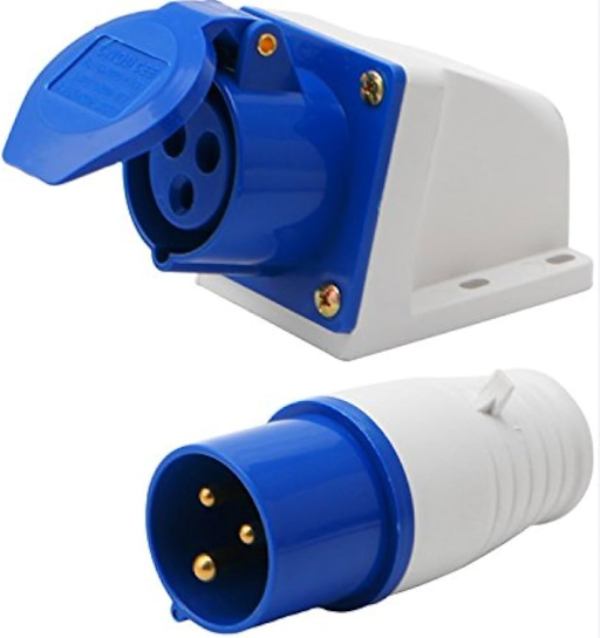
Industrial plugs and sockets provide safe, removable power connections for machinery, construction equipment, workshops, generators and commercial facilities. Unlike ordinary domestic connectors, industrial variants are designed to handle higher loads, regular connection cycles and demanding operating conditions.
Dollex Control Panel Accessories provides industrial electrical products for contractors, machine builders, factories and panel manufacturers. Selecting the right plug and socket requires careful matching of current rating, voltage, pole configuration and environmental protection.
Start With the Current Rating
Industrial connectors are available in different current ratings, commonly including 16A, 32A, 63A and 125A. The correct choice depends on the connected load, cable capacity and protective device.
A higher-rated connector should not be selected automatically. Every part of the circuit—including the cable, breaker, plug, socket and equipment inlet—must be coordinated correctly.
Overloading a connector can cause excessive heat, contact damage and insulation failure.
Match the Voltage and Pin Configuration
Industrial plugs and sockets use defined pin arrangements to prevent incompatible connections. Depending on the application, the connector may be configured for single-phase or three-phase power.
Common options include:
- Two-pole plus earth
- Three-pole plus earth
- Three-pole plus neutral and earth
The voltage rating, frequency and number of poles must match the electrical system. The earth connection should never be removed or modified to make an incompatible plug fit.
Portable and Fixed Socket Options
Portable sockets are attached to flexible cables and are useful for extension leads, temporary power distribution and movable equipment.
Fixed sockets are mounted on walls, machinery or distribution panels. They provide an established connection point and are more suitable where equipment is connected at a defined location.
Panel-mounted sockets are integrated directly into control panels or equipment enclosures. They require correct cut-out dimensions and suitable enclosure sealing.
Selecting Industrial Connectors for Delhi Facilities
Industrial and construction environments in Delhi may expose electrical connections to dust, moisture, heat and rough handling. The required ingress protection rating should be selected according to these conditions.
Key factors to evaluate include:
- Current and voltage rating
- Number of poles
- Single-phase or three-phase supply
- Indoor or outdoor installation
- Dust and water exposure
- Operating temperature
- Frequency of connection and disconnection
- Cable diameter and entry arrangement
- Required mechanical durability
Outdoor connectors should have suitable covers and sealing arrangements. The rated protection applies only when the product is correctly assembled and fully connected or closed as designed.
Warning Signs That a Connector Needs Attention
Industrial plugs and sockets should be inspected periodically. Stop using a connector if it shows:
- Burn marks or discolouration
- Loose or bent pins
- Cracked housing
- Melted insulation
- Unusual heating
- Damaged seals or covers
- A loose cable entry
Replacing a damaged connector is safer than attempting a temporary repair with tape or improvised parts.
Installation and Operating Practices
Cable conductors should be terminated securely without loose strands. The cable gland or strain-relief mechanism must grip the outer sheath rather than individual conductors.
Users should switch off or isolate the load before disconnecting equipment whenever the system design requires it. Plugs should be removed by holding the body, not by pulling the cable.
Correctly matched industrial plugs and sockets improve connection safety, equipment portability and maintenance convenience. Contact Dollex Control Panel Accessories for assistance with selecting the appropriate configuration.